How it works
We understand your business before we write a word.
Not "AI magic" — a written methodology, a calendar that knows real dates in real markets, rules that block instead of advise, and a habit of saying "we're not sure yet" instead of guessing. Here's the whole thing, not the highlight reel.
The pipeline
From your website to a published post, in nine steps you can watch
A fixed sequence, not an agent wandering through options: the number of steps is known before it starts, every model call is metered, and “why did it decide that?” is answered by a record, not a transcript.
- 01
We read your business
Your website, plus a short questionnaire: what you do, why customers choose you, your story, the proof you can cite, and what you'd never claim.
- 02
You confirm what we understood
The brand brief is shown to you before anything is written. Edit any line; it's the only source of facts every post may use.
- 03
A strategist drafts the month
Positioning, the objection each theme answers, the funnel mix, the cadence — every choice with a plain-language reason attached.
- 04
Four reviewers read the draft
A marketer, a business owner, a local, and a sceptic. If any of them requires a change, the plan is rewritten before you see it.
- 05
You approve the plan
And that's the moment the month gets planned: dated slots on your days, at your hours, in your customers' timezone, around the calendar's quiet days.
- 06
Each post is written
Per platform, with the four decisions behind it recorded — theme, format, opening, ask — so what worked can be measured later.
- 07
Two checks, in code and by a second model
A rule that can't be talked round removes unlicensed urgency and unsupported claims; a different model scores the draft and sends it back if it's below the bar.
- 08
You approve each post
Edit it, ask for another take, or reject it and say why. Nothing publishes in your name without this tap.
- 09
It learns
Results are compared against the decisions that produced them, findings feed the next plan, and 'not enough posts yet to be sure' is said out loud.
A written methodology
24 written playbooks, not improvisation
Positioning, objections, proof, funnel stages, the shape of a push, each channel, each market's rules and each market's law, written down as data — not baked into a prompt nobody can read. One can be corrected and republished without a release, and every plan and post records exactly which version it used, so a change can be measured against what actually happened next. The method, in full →
A starting mix, not a free-for-all
Five recurring themes, weighted to start, then adjusted as evidence comes in — never past two hard limits.
- Educational — 30% Teaches something the customer half-knows
- Social proof — 20% A customer's own words or result
- Product — 25% What it is, what it costs, why this one
- Behind the scenes — 20% Process, people, place
- Offer — 5% A specific, time-bound reason to act now
Guardrail one: product and offer together never exceed half the calendar, whatever the mix drifts toward.
Guardrail two: never two offers in the same fortnight — an offer every week just trains people to wait for the next one.
Writing that doesn't sound machine-written
A model left to its own defaults reaches for the same handful of words every time. Around 40 of them are banned outright — a few examples:
The instruction isn't just "don't" — it's "instead". The rule of thumb we give it:
“We roast in 4kg batches on Tuesdays” beats “premium artisanal quality” — it's smaller, truer, and only a real business could say it.
Seven checks before you ever see a draft
Every post is checked in order, and a failure at any step sends it back to be rewritten — it doesn't warn and continue.
- 1
Grounding
Every fact traces back to your brand brief. Anything that doesn't is removed.
- 2
Banned vocabulary
No stock AI phrasing survives — see the vocabulary rule below.
- 3
Brand voice
Matches how you actually talk, breaks none of your rules.
- 4
Hard constraints
Nothing contradicts what you told us never to say.
- 5
Compliance
The market's advertising rules pass. This step blocks — it doesn't just advise.
- 6
One clear ask
Exactly one call to action, and it points somewhere you actually take orders.
- 7
Fits the platform
Length, formatting and hashtags suit where it's going.
Then it's scored 1–10 on specificity, voice match, and persuasiveness.
Below 7 on any one of those, the draft doesn't reach you — it goes back and gets rewritten first.
"Why did it pick this?" has an answer
Choosing which playbook, which pillar, which time slot to use is a plain filter against your business, not a model wandering freely through a pile of options — so every choice comes with a reason attached, because nothing gets chosen without one in the first place. That matters most on the day you ask "why did this change?" and expect a real answer.
A calendar that knows the calendar
120 occasions, seven countries, real dates
India, Sri Lanka, Australia, the US, UK, Germany and France — plus ten sub-national regions, because a date that's right for Delhi is wrong for Kerala. Onam is a Kerala occasion. Pongal is Tamil Nadu. Bihu is Assam. A calendar that treats a country as one place gets all three wrong.
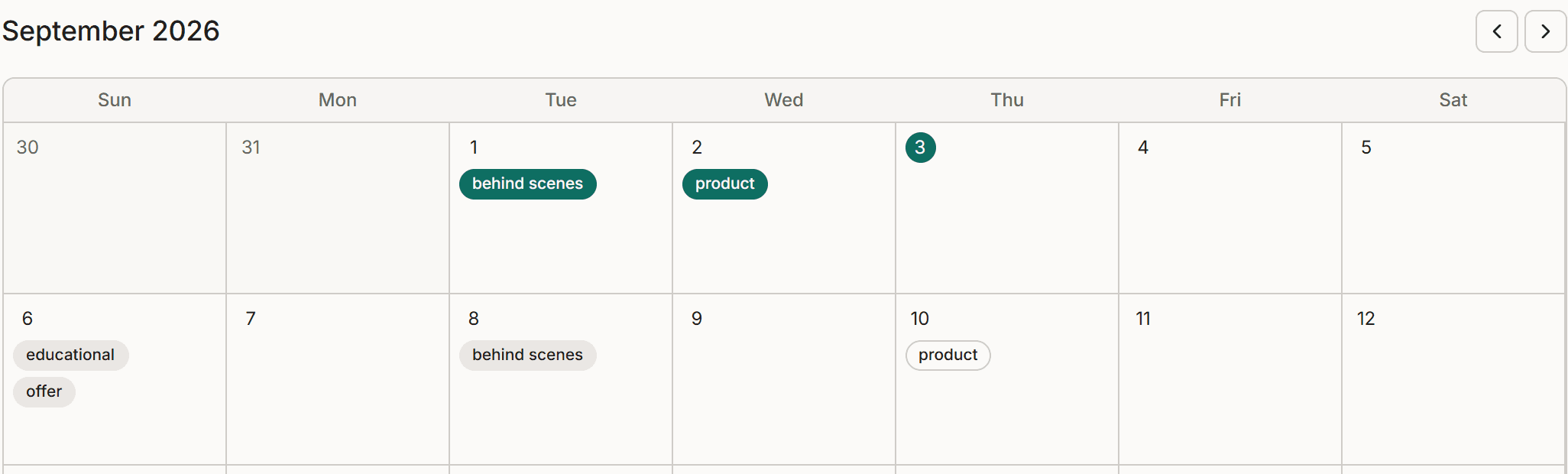 The actual calendar screen
The clearest example: Diwali doesn't have a fixed date
Diwali follows a lunisolar calendar, and roughly once every three years an extra month gets inserted to keep it in sync with the seasons. That single fact moves Diwali by nearly three weeks, and it moved in both directions across three consecutive years:
- 2025
- 20 Oct
- Third week of October
- 2026
- 8 Nov
- 19 days later in the year than 2025
- 2027
- 29 Oct
- 10 days earlier in the year than 2026
A calendar hardcoded to "the third week of October" starts the year's biggest sales ramp three weeks early, peaks into an empty room, and goes quiet on the actual day. We store the verified date for each specific year instead of a repeating rule.
Four stances, and two of them stop selling
Not every date on the calendar is a chance to sell. Some call for a greeting and nothing else; some call for silence.
Promote
“Good time to sell.”
Greet
“Say the greeting — don't sell.”
Soft only
“Soft content only, no hard sell.”
Suppress
“We won't post anything promotional.”
Knowing when to go quiet
In India, the fortnight before Diwali's own build-up is traditionally considered a poor time to buy. Hard sales pitches pause for that fortnight — reflective, low-key content keeps running — and switch back on the moment the next festival opens the shopping season.
Sri Lanka's thirteenth Poya
2026 has 13 Poya holidays, not the usual 12 — another inserted month. On a Poya day, shops close and alcohol and meat sales are prohibited by law. A scheduler built for twelve a year publishes straight into the thirteenth.
Some days are never for sale
ANZAC Day in Australia gets a greeting and never an offer, for every business in every category, no exceptions.
"Mother's Day" isn't one date
The US, the UK, Germany and France each mark it on a different day — the UK's "Mothering Sunday" moves with Easter. That's four separate entries, not one date copied four times.
When we can't confirm a date, we say so. Sources for Sri Lanka's 2027 Poya days contradicted each other, so those rows are deliberately left blank rather than filled with a best guess. A missing date produces a warning; a wrong one produces a campaign built on the wrong day. Absent beats plausible-and-wrong.
Rules that refuse, not soften
An unsupported claim gets removed — never reworded
An AI trained mostly on US and European marketing reaches for "Only 2 left!", "Hurry, ends tonight", or "boosts immunity" by default. Ordinary there; often unlawful elsewhere without real facts behind it. Rather than teach it to phrase those claims more carefully, we don't let them through at all.
The one rule enforced in code, every time, automatically:
Words like "hurry" or "only a few left" may only appear when there's a real offer behind them — one you've confirmed, with a real end date that hasn't passed yet. The moment that date passes, the claim stops being allowed, even if nobody remembers to turn the campaign off.
Everything else — health claims, mandatory disclosure wording, what a food business can and can't say, consent language — is written into a blocking rubric for each market we serve: India, Sri Lanka, Australia, and the US, UK and EU. Each is checked at step five of the seven-step gate above, and the commonest failures (invented urgency, invented stock, a health claim you never made) are also caught by code after the draft is written, so a slip in judgment cannot become a published post.
Staying honest
"Not enough posts yet" is the default answer, on purpose
A small business posts maybe thirty times a month. Split that across a handful of formats and times of day, and almost any comparison you could draw from it is noise — so we built the honesty in as the starting position, not an edge case.
Enough posts to compare
At least 5 posts on both sides of a comparison before we compare at all.
A clear lead, not a coin flip
The leading group's typical result has to be at least 1.5× the rest — a little ahead doesn't count.
Short of either bar, we don't call it — we say “not enough posts yet to be sure.” And when something does clear the bar, we'll say it's better. We never say a kind of post is worse — a result that isn't clearly ahead isn't evidence it's behind either.
Comparing across businesses
We won't show a benchmark against similar businesses until at least five different businesses' worth of data support it. In our earliest days, with only a handful of businesses on the platform, that mostly means an honest "not enough data yet" — which is the truth, not a bug.
The number we lead with
In a lot of the places we work, a sale doesn't start with a click — it starts with someone messaging you on WhatsApp and paying by UPI or cash when they pick it up. So the headline number is simple: did anyone get in touch? Impressions and click counts are there if you want them, tucked under "more numbers" — never the headline.
How it writes
Written the way people actually type
If your customers write in a mix of English and Hindi in Roman letters — which is how most people actually text online, not textbook Hindi in Devanagari script — that's what comes back. Language, script, and how mixed it is are three separate settings we track, not one, because "write in Hindi" and "write the way people actually message you" are two very different instructions. The result: copy that mixes the way people actually type, not sentences translated whole.
See it for your business
Paste your website or answer a short questionnaire. The first strategy brief is ready the same day, and nothing publishes until you say so.